




Introduction:
IS/IEC 62305 part 2, explains about the damages due to lightning strikes, sources of such damages, Losses due to lightning and the corresponding risks. In this article, we shall explore about the assessment of individual risk components and number of dangerous events due to lightning flashes as specified by IS/IEC 62305 part 2.
Number of Dangerous Events:
The number of dangerous events (NX) depends on the lightning ground flash density (NC) and the physical characteristics of the structure to be protected, lines connected to the structures and the type of soil.
The number N, depends on
- The lightning ground flash density NG
- Equivalent collection area of the structure,
- Factors which depends on the physical characteristics of the structure.

Lightning Ground Flash Density:
The lightning ground flash density NG is the number of lightning flashes per km² per year. If the value of NG for any particular location is not available, we can calculate the value by using the following formula.
NG = 0.1 * TD
TD - Number of thunderstorm days
Collection Area:
For simple rectangular structure, the collection area AD is the area defined by the intersection between the ground surface and a straight line with 1/3 slope from the upper parts of the structure and rotating it around the structure.
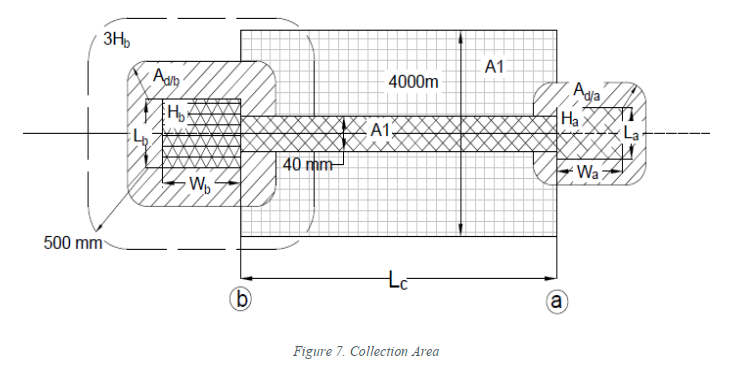
From the above formulae for calculating the number of dangerous events, we can observe that there are five different collection areas based on the location of the strike.
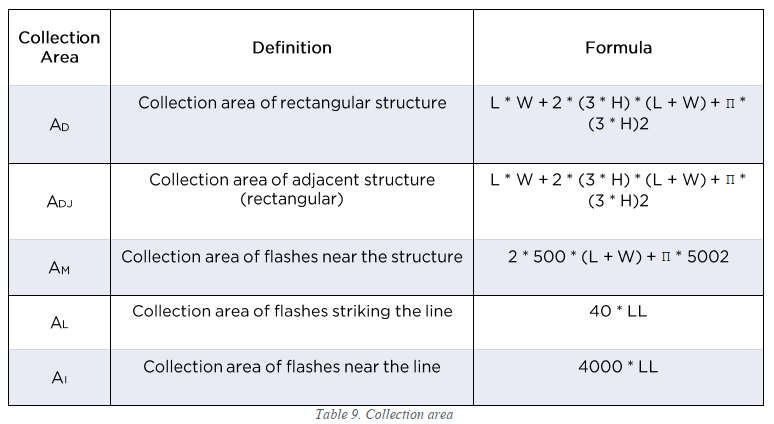
IS/IEC 62305 part 2 provides the values of all the factors (CD, CI, CE, CT, CDJ) involved in the calculation of number of dangerous event under Annexure A of IS/IEC62305 part 2.



































































Follow Us