




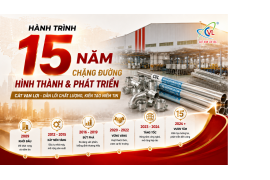
Nearly 20 years of Cat Van Loi’s development represent more than the growth of a manufacturing company. It is also a journey of changing mindsets, strengthening internal capabilities, and gradually bringing Vietnamese industrial products to international markets.
From the aspiration to manufacture products that Vietnam once relied heavily on imports for, Cat Van Loi has progressively invested in factories, technology, people, and quality management systems. Its products have been developed to meet international standards and reach overseas markets. This journey also reflects a broader ambition: moving from “Made in Vietnam” to “Made by Vietnam” — where Vietnamese enterprises do not simply manufacture in Vietnam, but increasingly take ownership of technology, standards, production capabilities, and competitiveness.
Looking back on nearly two decades, Cat Van Loi’s development can be described through three interconnected stages: Changing Mindset – Building Internal Strength – Going Global.
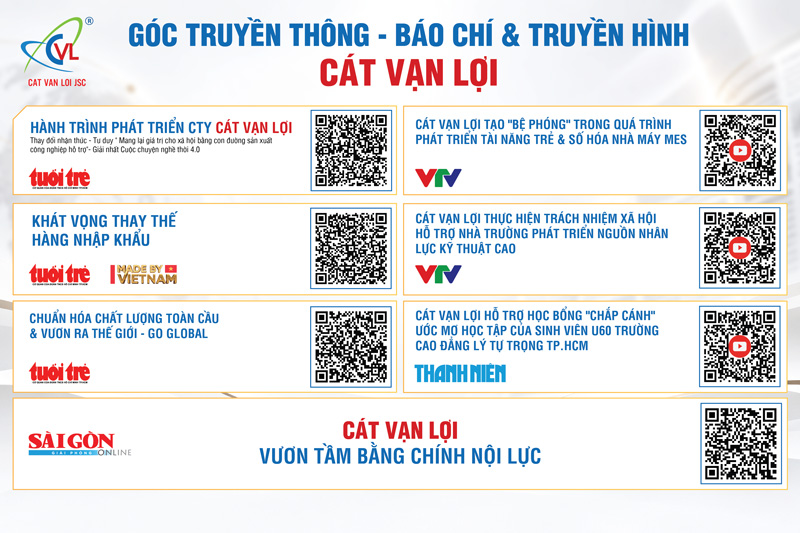
CHANGING MINDSET – FROM TRADING TO THE ASPIRATION OF MASTERING MANUFACTURING
Cat Van Loi was established in 2007, at a time when many mechanical and electrical materials used in Vietnamese construction projects still depended heavily on imported products.
During its early years in trading, direct exposure to the market revealed a larger question:
Why should products with strong domestic demand continue to be imported if Vietnamese companies are capable of researching, manufacturing, and mastering them?
That question gradually became the driving force behind a fundamental change in mindset.
Instead of focusing only on trading opportunities, Cat Van Loi chose a more challenging path: investing in industrial manufacturing, developing technical capabilities, and gradually mastering the production of MEP materials that had previously been largely sourced from overseas.
This was not simply a change in business model.
It represented a change in how the company viewed its role and responsibility.
A business seeking to create sustainable value cannot focus solely on short-term profit. Long-term value also lies in the ability to manufacture products, create jobs, develop technical human resources, and contribute to the country’s industrial capacity.
From this perspective, the aspiration to replace imported products with products developed and manufactured by Vietnamese enterprises gradually took shape.
BUILDING INTERNAL STRENGTH – TO GO FAR, A COMPANY MUST FIRST MASTER ITS OWN CAPABILITIES
Aspiration can only become reality when it is supported by strong internal capabilities.
For Cat Van Loi, building internal strength began with the fundamentals of industrial manufacturing: factories, machinery, technology, processes, standards, and people.
From its initial range of electrical and mechanical products, the company gradually invested in production systems, expanded manufacturing capacity, and developed a broader portfolio of products serving the M&E sector.
Today, Cat Van Loi operates a manufacturing facility covering approximately 15,000 square meters, with a production capacity exceeding 10,000 tons of steel per year. The factory operates under the ISO 9001:2015 quality management system, while its products are developed in accordance with various international technical standards, including UL, ANSI, JIS, BS, IEC, and DIN.
However, achieving a standard is only one milestone.
The real capability lies in maintaining consistent quality across every production batch, every project, and throughout the manufacturing process.
That is why Cat Van Loi has continuously invested in workforce training, process improvement, management capabilities, and the gradual digitalization of its manufacturing operations.
From producing individual product lines, the company has progressively developed a broader MEP materials ecosystem, including steel conduits, metal cable trays, fittings, lightning protection and grounding systems, and other related solutions.
Throughout this process, Cat Van Loi has increasingly recognized that the long-term competitiveness of Vietnamese manufacturing cannot depend on price alone.
To compete with international products, Vietnamese manufacturers must compete through quality, standards, supply capability, service, and consistency.
Internal strength, therefore, is not measured only by factory size or the number of machines installed. It is measured by the ability to control the entire process required to create products capable of competing alongside those from established industrial economies.
GOING GLOBAL – BRINGING VIETNAMESE PRODUCTS INTO THE GLOBAL SUPPLY CHAIN
Once a strong manufacturing foundation had been established, another question emerged:
If Vietnamese products can meet demanding requirements in major domestic projects, why should they not compete in international markets?
That question marked the beginning of Cat Van Loi’s journey beyond Vietnam.
Its products have gradually reached markets including Japan, Myanmar, Cambodia, the Philippines, Singapore, and others, while also being supplied to contractors, corporations, and projects with stringent technical requirements.
For an industrial manufacturer, every product that crosses a national border represents more than an export order.
Behind each shipment are requirements related to technical standards, documentation, quality control, delivery schedules, and the ability to maintain consistency throughout the supply chain.
These requirements, in turn, push the company to continue improving.
Going global is therefore not a single milestone, but a continuous process of raising standards.
From serving domestic demand and replacing part of the country’s imported materials, Cat Van Loi is now working toward the next stage of development: bringing Vietnamese industrial products deeper into regional and global supply chains.
This also represents a shift from the mindset of “being able to manufacture” to “manufacturing to international standards,” and from “serving the domestic market” to “building the capability to compete globally.”
FROM “MADE IN VIETNAM” TO “MADE BY VIETNAM”
Nearly 20 years may not be considered a long period in industrial development.
Yet it has been long enough for Cat Van Loi to move from trading to manufacturing, from manufacturing to standardization, and from the domestic market to international markets.
Behind factories, production lines, and certifications lies a more fundamental transformation: a change in how Vietnamese enterprises view their own capabilities.
While “Made in Vietnam” identifies where a product is manufactured, the aspiration of “Made by Vietnam” carries a greater ambition: that Vietnamese businesses increasingly take ownership of the ideas, technology, processes, quality, and brands behind those products.
Cat Van Loi understands that no single company can build an entire industrial economy.
However, if each Vietnamese enterprise performs its role well — producing better products, mastering more technologies, replacing more imported goods, and bringing more Vietnamese products into international supply chains — each company can become an important link in the development of the country’s industrial foundation.
The ultimate goal of this journey is therefore not only to bring Cat Van Loi to the world.
It is also the aspiration to work alongside the Vietnamese business community in building a self-reliant and resilient mechanical and industrial sector, where Vietnamese enterprises can proactively manufacture the products the market needs, meet the standards required by the world, and compete through their own capabilities.
Change the mindset to see the path ahead.
Build internal strength to be capable of walking that path.
Go global to demonstrate the capabilities of Vietnamese products.
That is the journey Cat Van Loi has pursued for nearly 20 years — and it is a journey that continues with a greater ambition: to bring Vietnamese brands deeper into the global supply chain and contribute to building a more self-reliant and resilient industrial Vietnam.







































































Follow Us