




Introduction:
There are no methods or devices that can prevent lightning discharges. The lightning protection system (LPS) can be installed to protect the structures against lightning.
An external Lightning Protection System is intended to
1) Capture the lightning flash to a structure. (Air terminal system)
2) Conduct the lightning current safely from air terminal to the earth. (Down conductor system)
3) Dissipate the lightning current into the earth. (Earthing system)
The air termination system can be composed of rods, catenary wires or meshed conductors.
The following methods are used to determine the position of air termination system.
1) Protection Angle Method
2) Rolling Sphere Method and
3) Mesh Method
Protection Angle Method:
The structure is considered to be protected if it is fully situated within the volume protected by the air-termination system. PAM can be used for the placement of following air termination systems,
- Vertical rod air - termination system
- Wire air - termination system
- Wires combined in a mesh
The volume protected by a vertical air termination rod will be in the shape of a right circular cone and hence it is also called as Cone of Protection method. The semi-apex angle will be a and it depends on the class of LPS and the height of air-termination system from the reference plane.

From the figure,
H - height of the building
h1 - physical height of air terminal rod
h2 - overall height of air terminal from ground reference plane.
α1 - protection angle corresponds to height h1
α2 - protection angle corresponds to overall height (H + h1)
The protection angle for various heights of air - terminals can be found by using the following graph. Based on the height and protection angle, we can calculate the protected area.

The angle will not change for values of h below 2m. In PAM, each level of LPS has its limitation on the height of air - terminal (LPL I - 20m, LPL II - 30m, LPL III - 45m & LPL IV - 60m), beyond which this method is not applicable.
Example:
Let us consider an air - terminal with overall height of 10m. We can find the protection angle for all the four levels from the graph.


Similarly, we can find the protection distance for any height and any levels of protection. If a structure to be protected cannot be covered using a single air terminal we have to go for multiple terminals placed as per the coverage distance and all the terminals should be inter connected to form a network. The placement of air terminal using PAM is shown below.

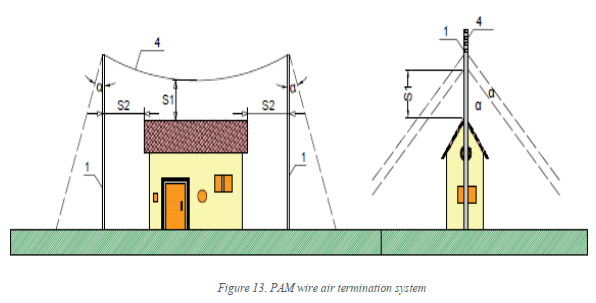
Using the same method, we can calculate the protection area for wire air - termination system as shown.


































































Follow Us