




Introduction:
There are no methods or devices that can prevent lightning discharges. The lightning protaction system (LPS) can be installed to protect the structures against lightning. IS/IEC 62305-3 specifies the following three methods to determine the position of air termination system
1) Protection Angle Method
2) Rolling Sphere Method and
3) Mesh Method
Protection angle method is suitable for simple shaped buildings and it also has limitations on the height of the air terminal. The mesh method is suitable where plane surfaces are to be protected Whereas rolling sphere method can be used in all the cases.
Rolling Sphere Method:
In this method, an imaginary sphere of radius 'r' is rolled over the structure to be protected in all possible directions. The structure is considered to be protected if the sphere doesn't make any contact with the structure. The sphere should have contact only with the air terminal and on the ground. The radius of the sphere depends on the level of protection.
The radius of the rolling sphere for different classes of LPS are as follows:

The radius of the rolling sphere with respect to the peak value of the current in the lightring that strikes the structure,
r = 10 * I 0.65
Where, I-peak lightning current in kA.
The rolling of sphere over the structure is shown below.
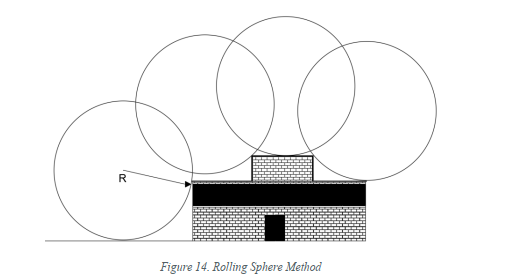
If the height of the structure is greater than 60m then additional protection measures of installing vertical conductors for the top 20% has to be provided to reduce the effect of side flashing.

Let us consider a rod air terminal placed at the top of a building. The protection provided by the air terminal as per rolling sphere method for different classes of LPS are shown herein:

From the above image, we can find that the protected region varies for different classes of LPS and different heights of air terminal. The air terminals should be placed in such a way that the sphere does not make any contact with the structure to be protected.
Penetration distance:
The distance between the two air terminals should be chosen in such a way that, the protection is provided for all the objects placed on the surface to be protected. The protection of the objects placed on the surface can be ensured by calculating the penetration distance of the rolling sphere. The distance between the level of air terminals and the least point of sphere in the space between the air terminals is called penetration distance. By comparing the penetration distance with the height of the object placed between the air terminals, we can find whether the object placed is protected or not.

Let us consider an object of height 'h' placed on the surface to be protected. Let ‘ht’ be the height of the air terminal, 'p' be the penetration distance and 'd' be the distance between the two terminals. In this case, the penetration distance should be less than the difference between the height of air terminal and height of the object to be protected.
p < (ht - h)
Distance between air terminals:
The penetration distance of the rolling sphere below the level of conductors in the space between the conductors can be calculated by using the below formula provided by IS/IEC62305-3.
p= r- [r²- (d/2)2]1/2
Where,
p - penetration distance
r - radius of rolling sphere
d - distance between the air terminals
For attaining a particular penetration distance, we can derive the required distance between the air terminals from the above equation.
d = 2*[2*p*r - (p)²]1/2
If there are no objects protruding from the structure to be protected, then the penetration distance can be increased up to the height of the air terminal to provide maximum protection. At this condition, the distance can be calculated by substituting the value of height of air terminal (ht) in place of penetration distance (p). The distance should always be lesser than the calculated value.
d= 2*[2*ht*r - (ht)2]1/2
Sample Calculation:
Based on the above formula for finding the distance between the air terminals, let us calculate for different heights (0.5m, 1mand1.5m) of air terminals for four different classes of LPS.

From the above analysis, we can conclude that the distance between the air terminals (d) in rolling sphere method depends on two factors.
1) Height of the air terminal and
2) Radius of the rolling sphere
Among these two factors, the radius of rolling sphere is a constant value which depends on the class of LPS as specified by IS/IEC 62305-3. Hence for particular class of LPS, the distance between the air terminals purely depends on the height of air terminal.







































































Follow Us