




Overview of UL Organization
UL, short for Underwriters Laboratories, is a global private safety company headquartered in Northbrook, Illinois, USA. Founded in 1894, its original mission was to test electrical and fire safety products. Today, UL consists of three main divisions: UL Research Institutes, UL Standards & Engagement, and UL Solutions. Each plays a crucial role in developing safety standards, performing product testing, and granting certifications worldwide.
History and Development of UL
The establishment of UL is closely tied to William Henry Merrill, an MIT electrical engineering graduate. After working as an electrical inspector for the Boston Fire Insurance Patrol, Merrill recognized the rising risks of fire caused by electricity. He proposed creating a laboratory to test electrical and fire safety products. Although rejected in Boston, he moved to Chicago in 1893, where he founded UL in 1894 with support from local insurance organizations.
In its early years, UL mainly tested fire extinguishers, fire-resistant equipment, and highly flammable products such as wires. These tests laid the foundation for UL to become a global certification body, expanding its scope to consumer products throughout the 20th century, including vacuum cleaners, televisions, microwave ovens, and personal computers.
UL Certification and Standards
UL has developed over 1,500 safety standards across diverse sectors, covering electrical systems, industrial equipment, consumer electronics, and safety-related products. Below are key categories of UL standards:
1. Sustainability Standards
-
UL 106: Sustainability standard for lighting (under development).
-
UL 110: Sustainability standard for mobile phones.
2. Electrical & Electronic Products
Covers safety requirements for switchgear, household appliances, IT systems, and electronics.
-
UL 50, UL 50E: Electrical enclosures.
-
UL 153: Portable lamps.
-
UL 197: Commercial electric cooking appliances.
-
UL 410: Slip-resistant floor materials.
-
UL 651: Rigid PVC conduit and fittings.
-
UL 796: Printed wiring boards.
-
UL 962B: Display power distribution equipment.
-
UL 1598: Luminaires.
-
UL 1642: Lithium batteries.
-
UL 1653: Nonmetallic conduit.
-
UL 1995: Heating and cooling equipment.
-
UL 60335 series: Household electrical appliances.
-
UL 62368-1: Audio/video, IT and communication equipment.
3. Life Safety Standards
Focus on fire alarms, smoke detection, warning signals, and personal protection.
-
UL 217: Smoke alarms.
-
UL 268: Smoke detectors.
-
UL 752: Bullet-resisting materials.
-
UL 1971: Signaling devices for the hearing impaired.
4. Building Products
-
UL 10A: Tin-clad fire doors.
-
UL 20: General-use snap switches.
-
UL 486E: Wire connectors.
-
UL 1256: Fire test of roof and floor assemblies.
5. Industrial Control Equipment
-
UL 508: Industrial control equipment (replaced by UL 60947-4-1).
-
UL 508A: Industrial control panels.
-
UL 508C → UL 61800-5-1: Power conversion equipment.
6. Plastic Materials
Evaluate flame resistance, heat resistance, and durability of polymers.
-
UL 94: Flammability tests.
-
UL 746 series: Properties of polymeric materials.
7. Wire and Cable Standards
-
UL 62: Flexible cords and cables.
-
UL 817: Cord sets and power-supply cords.
-
UL 2556: Wire and cable test methods.
8. Alarm Systems, Installation & Monitoring
Covers burglar alarms, fire alarms, and cybersecurity.
-
UL 294: Access control equipment.
-
UL 464: Audible signal devices.
-
UL 681: Installation and classification of burglar and holdup alarm systems.
-
UL 827: Central station services.
-
UL 2900 series: Cybersecurity for connected products.
9. Photovoltaic and Renewable Energy Standards
-
UL 1703: Flat-plate photovoltaic modules.
-
UL 1741: Inverters, converters, controllers for distributed generation.
-
UL 2703: Mounting systems for PV modules.
UL Solutions – Expanding Across Safety Fields
Over decades, UL has grown beyond electrical and fire safety into areas like food safety, water quality, and sustainability standards. In 2012, UL became UL LLC, focusing on product testing and certification.
In 2022, UL restructured into three independent organizations: UL Solutions, UL Standards & Engagement, and UL Research Institutes. Following its April 2024 IPO, UL Solutions achieved a valuation of approximately USD 7 billion.
Importance of UL Certification
UL certification is considered one of the most trusted marks in industry, helping manufacturers ensure product safety, reliability, and regulatory compliance. Products with UL certification not only meet stringent U.S. and EU requirements but are also trusted by global markets.
For more than a century, UL has built a global reputation in safety science and certification. With its comprehensive standards and rigorous testing, UL not only safeguards consumers but also strengthens the credibility of manufacturers worldwide.
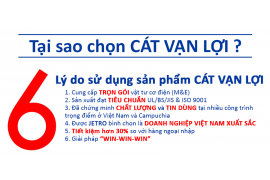
Cat Van Loi – Vietnam’s Manufacturer of MEP Materials with International Certifications
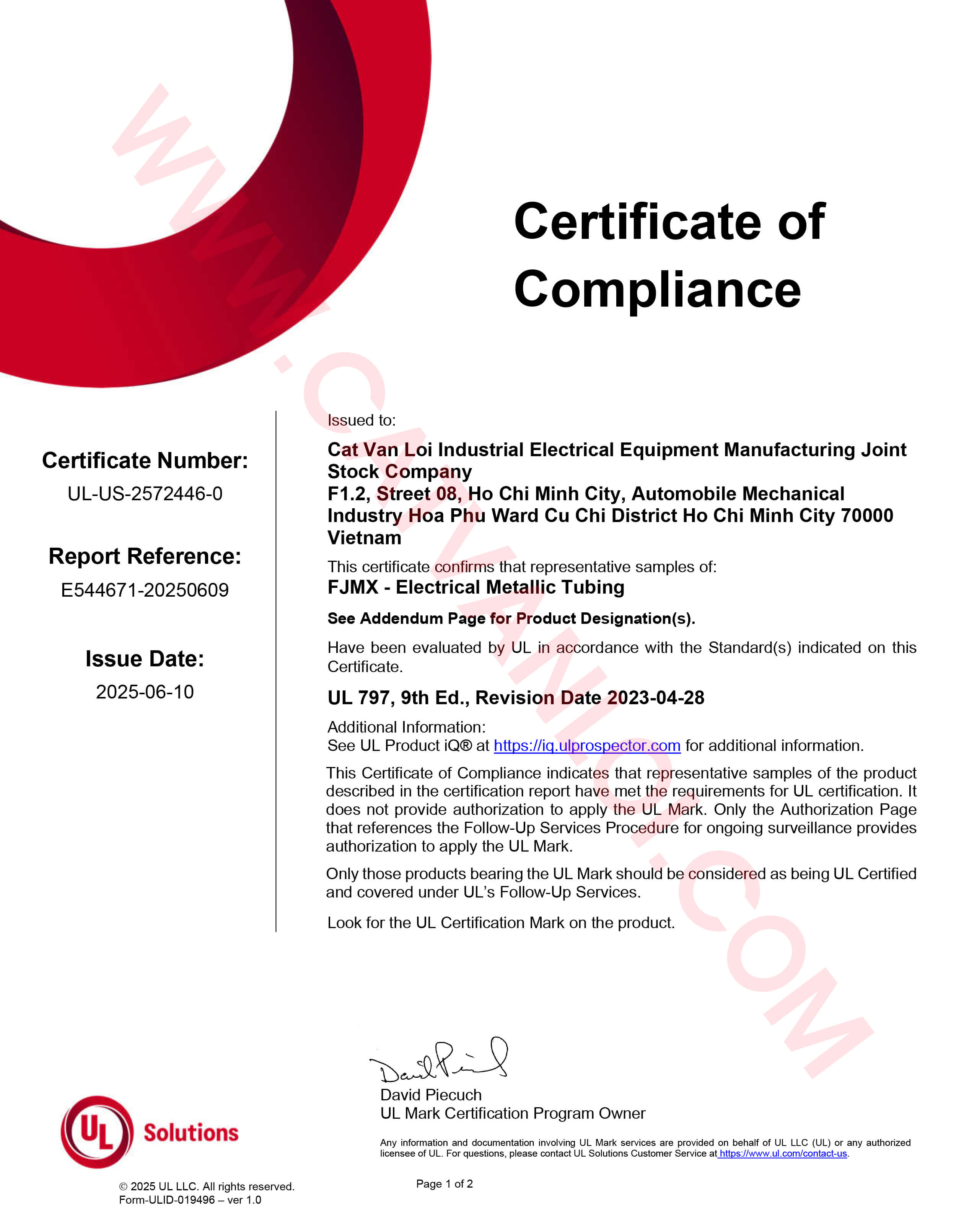
In Vietnam, Cat Van Loi is a pioneer in manufacturing MEP materials that meet prestigious international certifications. The company has been awarded UL 797 for its EMT steel conduit and NEMA BI 50015 for its wire mesh cable tray. These certifications mark an important milestone, affirming the quality and safety of Cat Van Loi’s products while expanding opportunities for export to demanding global markets. With a sustainable development strategy, Cat Van Loi remains committed to delivering internationally certified MEP solutions to customers both domestically and worldwide.


































Follow Us